
Understanding Disability
- Home
- Understanding Disability
Defining And Understanding Disability
Defining disability is not a simple process. Different people view disabilities from different reference points and as such, they define the concept based on their own unique perspectives and interactions. Persons with disabilities, regulators, employers, insurance companies and persons without disabilities are all likely to have a different idea of what a disability is. This is problematic as it leads to different approaches and solutions when attempting to address or act on the topic.
Many people with disabilities perceive definitions to be mechanisms that are used to exclude and marginalise them, rather than as enabling tools for positive action, development and social integration.



The Social Model Explained
According to the United Nations Convention on the Rights of Persons with Disabilities (UNCRPD), disability is an evolving concept and disability results from the interaction between persons with impairments and attitudinal and environmental barriers. It recognises persons with disabilities as those persons who have long-term physical, mental, intellectual or sensory impairments which, in interaction with various barriers, may hinder their full and effective participation in society on an equal basis with others.
South Africa defines disability as the loss or elimination of opportunities to take part in the life of the community, equitably with others, that is encountered by persons having physical, sensory, psychological, developmental, learning, neurological or other impairments that may be permanent, temporary or episodic in nature, thereby causing activity limitations and participation restriction with the mainstream of society. These barriers may be due to economic, physical, social, attitudinal and/or cultural factors.
Therefore, disability is the consequence of an impairment that may be physical, cognitive, mental, sensory, emotional, developmental, or some combination of these. A disability may be present from birth, or occur during a person’s lifetime. This definition is referred to as the “social model”.
The South African Human Rights Commission endorses the UNCRPD approach, and encourages all employer groups to incorporate this application and understanding of disability into their policies and practices.
The Employment Equity Act (EE Act) provides details relating to the criteria for establishing whether a disability exists. These elements must be understood and applied in conjunction with the “social model” definition. According to the EE Act, people with disabilities are those who have a long-term or recurring physical or mental impairment which substantially limits their prospects of entry into, or advancement in, employment.
In attempting to assess whether the impairment constitutes a disability, the following criteria must be evaluated.
The Department of Labour’s Technical Assistance Guideline (TAG) outlines three basic qualifying criteria to determine if a person has a disability – and provides guidelines to assist in the application and understanding of these criteria:
An impairment may either be physical or mental or a combination of both. A physical impairment means “a partial or total loss of a bodily function or part of the body. It includes sensory impairments such as being deaf, hearing impaired or visually impaired”.
A mental impairment is a clinically recognised condition or illness that affects a person’s thought processes, judgement or emotions. This includes conditions such as intellectual, emotional and learning disabilities. For reasons of public policy, certain conditions or impairments may not be considered as disabilities.
Long-term means the impairment has lasted for or is likely to persist for at least twelve months. Recurring means the impairment in one that is likely to happen again and when it does, it is substantially limiting. The condition can go away for a period of time and return again but it is never cured. It includes a constant chronic condition, even if its effects on a person fluctuate, such as is the case in some forms of multiple sclerosis.
Progressive conditions are those that are likely to develop or change or recur. People living with progressive conditions or illnesses are considered as people with disabilities once the impairment starts to be substantially limiting.
Progressive or recurring conditions which have no overt symptoms or which do not substantially limit a person with no disabilities – for example, a person with cancer, tuberculosis or HIV would not be covered under the EE Act until the symptoms substantially limit the person’s ability to perform their job.
An impairment is substantially limiting if its nature, duration or effects substantially limit a person’s ability to perform essential functions of the job for which he/she is being considered. If the effects of the impairment are not substantially limiting, even if they are physical and/or mental, are long-term or recurring, then the person is not covered under the EE Act. Employers are encouraged to seek the assistance and advice of technical experts to determine whether a particular impairment is substantially limiting, or an applicant or employee may be able to provide information that is deemed sufficient to document this.
In applying our understanding to the criteria to determine whether there is a disability, one needs to remember that an impairment is a problem in body function or structure; an activity limitation is a difficulty encountered by an individual in executing a task or action; while a participation restriction is a problem experienced by an individual in involvement in life situations. Disability is therefore not just a health problem. It is a complex phenomenon, reflecting the interaction between features of a person’s body and features of the society in which he or she lives. Overcoming the difficulties faced by people with disabilities requires interventions to remove environmental and social barriers.
Challenges Employers Face When Hiring People with Disabilities (PWD)
Employers who aim to create an inclusive environment for people with disabilities may encounter several challenges. Understanding these challenges can help companies implement effective strategies to support PWD in the workforce.
Employers often worry about the potential costs associated with providing necessary accommodations for PWD. This could include modifying workstations, investing in assistive technologies, or altering facilities to improve accessibility. However, many accommodations are cost-effective and can lead to increased productivity and job satisfaction.
A lack of awareness about disabilities and how to support PWD can lead to misconceptions and biases. Employers may not fully understand the capabilities of PWD or the types of accommodations required. Offering training and education programs can help staff recognize and overcome these barriers.
Communication can be a challenge, particularly for employees with sensory disabilities. Employers may need to implement tools like sign language interpreters, captioning services, or alternative communication methods to ensure clear and effective interactions.
Employers sometimes struggle to access resources and networks that can assist them in hiring and supporting PWD. Establishing partnerships with organizations that advocate for PWD can provide valuable insights and resources.
Societal prejudices and stigmas about disabilities can infiltrate workplace culture, impacting the integration and success of PWD. Employers must actively work to foster an inclusive culture that values diversity and challenges stereotypes.
Navigating the legal requirements related to hiring PWD, such as ensuring compliance with anti-discrimination laws and providing reasonable accommodations, can be complex. Employers need to stay informed about relevant legislation and best practices to avoid legal pitfalls.
Supporting the ongoing development and retention of PWD can be challenging if employers do not have adequate programs in place. Creating clear career paths, offering mentorship, and providing opportunities for professional growth can help retain talented PWD in the workforce.
By addressing these challenges, employers can create an environment where PWD feel valued and empowered, ultimately enhancing the overall diversity and effectiveness of their teams.

Solutions for Employers when Hiring People with Disabilities (PWD)
Creating an inclusive workplace for people with disabilities involves overcoming several challenges. Here are some solutions to address these challenges effectively:
Solution: Employers can explore funding opportunities and tax incentives that offset accommodation costs. Many governments offer financial assistance for workplace modifications. Additionally, engaging with disability advocacy groups can provide cost-effective accommodation solutions. Implementing accommodations often results in increased employee productivity and retention, which can offset initial costs.
Solution: Implement comprehensive training programs to educate employees about disabilities and the benefits of an inclusive workplace. Training should cover understanding different types of disabilities and appropriate communication methods. Partnering with organizations specializing in disability inclusion can provide valuable resources and expert guidance.
Solution: Employers should invest in assistive technologies and services that facilitate communication. These might include sign language interpreters, captioning services, and speech-to-text software. Regular feedback sessions with employees with disabilities can help identify and address ongoing communication needs.
Solution: Establish partnerships with organizations that advocate for and support PWD. These partnerships can provide access to a wealth of resources, including training materials, recruitment networks, and accommodation advice. Joining industry networks focused on disability inclusion can also offer ongoing support and insights.
Solution: Foster an inclusive workplace culture by promoting diversity and challenging stereotypes through awareness campaigns and workshops. Encourage open dialogue and create channels for employees to share their experiences and suggestions. Recognizing and celebrating the achievements of employees with disabilities can also help shift perceptions.
Solution: Employers should stay informed about relevant legislation by consulting legal experts and attending seminars on disability inclusion. Developing a compliance checklist and regularly auditing hiring practices can ensure adherence to legal requirements. Providing training for HR staff on legal obligations and inclusive practices is crucial.
Solution: Develop tailored career development programs for employees with disabilities, including mentorship opportunities and skill-building workshops. Encourage participation in professional networks and offer flexible career paths that accommodate diverse needs. Providing regular feedback and support can enhance job satisfaction and retention.
How Employers Can Be More Accommodating
- Engage in Open Dialogue: Regularly communicate with employees with disabilities to understand their needs and gather feedback on workplace practices.
- Promote Flexible Work Arrangements: Offer remote work options, flexible hours, and part-time positions to accommodate various needs.
- Create Accessible Workspaces: Ensure physical accessibility by installing ramps, elevators, and accessible restrooms. Adapt workstations with ergonomic furniture and necessary technology.
- Celebrate Diversity: Recognize and celebrate diversity through events, workshops, and inclusive policies that promote a sense of belonging.
By implementing these solutions and fostering an accommodating environment, employers can create a workplace that not only attracts but also retains talented individuals with disabilities, enriching the organization with diverse perspectives and skills.
Different Types of Disabilities in Persons with Disabilities (PWD) in the Workforce
Individuals with disabilities bring diverse perspectives and skills to the corporate workforce. Here are some types of disabilities that people may have while still being part of the workforce:
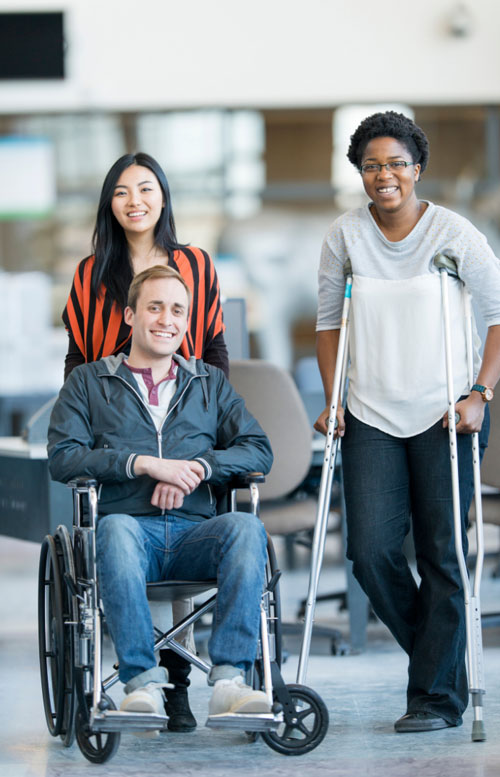
Physical disabilities may affect a person's mobility or physical capacity. This includes individuals who use wheelchairs, crutches, or prosthetic limbs. Many workplaces are equipped with accommodations such as ramps, elevators, and specialised equipment to support these employees.
Sensory disabilities involve impairments in sight or hearing. For example, individuals who are blind or have low vision might use screen readers or Braille displays, and those who are deaf or hard of hearing may utilise sign language interpreters or captioning services during meetings.
Individuals with intellectual disabilities may experience limitations in intellectual functioning and adaptive behavior. With appropriate support and job coaching, many can perform effectively in various roles, contributing valuable insights and perspectives.
Learning disabilities affect the way individuals process information. For example, dyslexia can impact reading skills, while dyscalculia affects mathematical understanding. Employees with learning disabilities can thrive in the workplace with accommodations like specialised software or adjusted training programs.
Mental health conditions, such as anxiety, depression, or bipolar disorder, can influence an employee's mood and behaviour. Employers can support these individuals by fostering an inclusive work environment, offering flexible work arrangements, and providing access to mental health resources.
Neurodiversity includes conditions such as autism spectrum disorders or ADHD. Individuals with these conditions often excel in roles that require attention to detail, pattern recognition, or creative problem-solving. Accommodations might include quiet workspaces or flexible scheduling.
Chronic health conditions like diabetes, arthritis, or multiple sclerosis may require employees to manage ongoing health challenges. Employers can support these individuals through flexible scheduling, remote work options, and providing ergonomic workstations.
By understanding and accommodating the needs of individuals with various disabilities, workplaces can harness a wide range of talents and perspectives, fostering an inclusive and dynamic corporate environment.

Be Part of South Africa's Inclusive Talent Movement!
Where every background, identity, and ability isn’t just welcomed—it’s celebrated!
Share your details below and join the Mzansi family. Whether you’re a candidate seeking meaningful opportunities or an organization committed to building a truly diverse workforce, your journey to transformation starts here.
Together, we’re not just filling positions—we’re creating possibilities for all of South Africa.